




About the Institute and Its Distinctive Features
The Institute of Community Health Care, College of Nursing, National Yang Ming Chiao Tung University, was approved by the Ministry of Education in October 2014 and officially began admitting students in the 2015 academic year. The Institute is dedicated to cultivating students’ professional knowledge and competencies in community health nursing and health management, with an emphasis on mobilizing community capacity, integrating resources, promoting community development, and developing insight into trends associated with environmental and societal change.
Through the integration of health promotion theories and professional nursing knowledge, students are prepared to foster the concepts of health autonomy and personal responsibility, and to apply health promotion, disease prevention, and health management strategies in community settings, thereby enhancing the overall health and well-being of populations.
During practicum experiences, students apply the nursing process to provide holistic, continuous, and high-quality care that addresses clients’ physical, psychological, spiritual, social, and cultural needs. The curriculum also places strong emphasis on personal growth and professional development, encouraging students to effectively utilize research findings and actively participate in research activities. Through these experiences, students are equipped to further improve the quality of nursing care for individuals, families, and communities, while also contributing to the development and formulation of health policies.
Admissions Highlights
As Taiwan’s first institute dedicated to community health care established within a College of Nursing, the Institute brings together faculty members with diverse areas of expertise encompassing population health issues across the lifespan in community settings. We welcome graduates from nursing and other academic disciplines who are committed to pursuing professional development in the field of community health.
The Institute emphasizes health care practice and research grounded in case management and community health promotion, integrating community-based practice with theoretical foundations and promoting systematic and continuous health care across hospitals, workplaces, and community settings. The curriculum is also designed to meet practicum-hour requirements relevant to advanced nursing practice and other health care professions.
Curriculum Features
Integrates population health theories, evidence-based research findings, and professional health care knowledge and competencies.
Promotes community empowerment, integrates community resources, and facilitates community development.
Cultivates community health care professionals with interdisciplinary and interprofessional competencies.
Advocates for health equity and provides culturally competent care.
Enhances the quality of population-based community health care through practice and research.
Provides high-quality, holistic, and continuous population health care.
Core Competencies
1. Clinical Decision-Making
2. Evidence-Based Care
3. Interdisciplinary and Interprofessional Teamwork
4. Humanistic Care
5. Leadership in Practice
6. Cross-Cultural Care
7. Community Health Care
Vision and Future Development
1. Deepening Interdisciplinary Collaboration: Integrate information technology, electrical engineering, and health care to develop smart health care solutions, with particular emphasis on improving the allocation of health care resources and promoting health among rural and underserved populations, as well as advancing occupational health.
2. Expanding Academic Programs and Talent Development: Plan for the establishment of a doctoral degree program to cultivate advanced researchers in community health care. At the same time, strengthen in-service training and continuing education programs to enhance the professional competencies of practicing health care personnel.
3. Strengthening International Exchange and Collaboration: Actively establish collaborative networks with internationally renowned universities and research institutions, promote overseas exchanges for students and faculty as well as joint research initiatives, and enhance the international visibility and impact of research outcomes.
4. Advancing Innovation in Community-Based Practice: Deepen collaboration with local governments and community organizations to establish systematic and continuous health care linkages across hospitals, workplaces, and community settings, integrating health management, disease prevention, and long-term care services.
5. Enhancing Policy Impact and Social Engagement: Provide evidence-based policy recommendations through research, participate in the development of health care policies, and strengthen public awareness of and support for community health care.
Curriculum Map
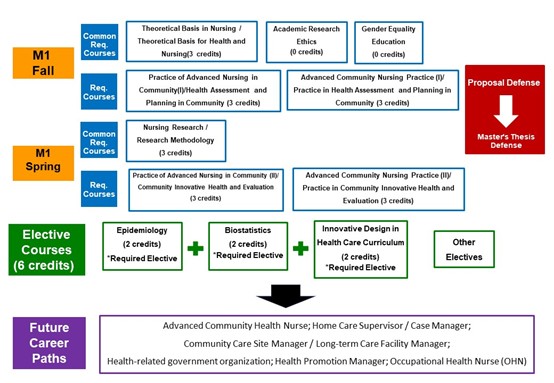
This curriculum map presents the course structure of the Institute of Community Health Care by semester, course category, elective requirements, academic milestones, and future career paths.
In the first semester of the first year, common required courses include Theoretical Basis in Nursing / Theoretical Basis for Health and Nursing (3 credits), Academic Research Ethics (0 credits), and Gender Equality Education (0 credits). Required courses include Practice of Advanced Nursing in Community (I) / Health Assessment and Planning in Community (3 credits) and Advanced Community Nursing Practice (I) / Practice in Health Assessment and Planning in Community (3 credits).
In the second semester, the common required course is Nursing Research / Research Methodology (3 credits). Required courses include Practice of Advanced Nursing in Community (II) / Community Innovative Health and Evaluation (3 credits) and Advanced Community Nursing Practice (II) / Practice in Community Innovative Health and Evaluation (3 credits). Students must also complete 6 credits of elective courses, including three required electives: Epidemiology (2 credits), Biostatistics (2 credits), and Innovative Design in Health Care Curriculum (2 credits), along with other electives. Academic milestones include the Proposal Defense followed by the Master’s Thesis Defense.
Future career paths include Advanced Community Health Nurse, Home Care Supervisor, Case Manager, Community Care Site Manager, Long-term Care Facility Manager, Health-related government organization, Health Promotion Manager, and Occupational Health Nurse (OHN).